Thursday, 3 December 2015

Vienna Secession, Art Nouveau and Art Deco - Research

1896 saw the birth of the Vienna Secession, led by Gustav Klimpt and a number of other artists. They resigned from the Association of Austrian artists because of the orientation towards traditional historicism. The Vienna Secession was a precursor to Art Nouveau and also Art Deco, and in its own way provided a foundation for Modernism. The group built a building named after their movement in Vienna, and it featured what soon became their defining symbol; a leafwork dome of gold. Joseph Olbrich was the one to design and build the construction, but it was artists such as Klimpt who took the golden leaf motif and made it iconic for the Secession, Art Nouveau and Art Deco. The movement did not have a specific style, however, and that was the point - it was truly modern in the sense that they wanted to create a new style that had nothing to do with historical influence. The phrase "to every age its art, to every art its freedom" is emblazoned on the doorway of the Secession building, and it sums up their views nicely.
Klimpt's work is linked to Freudian psycho-analysis in that Klimpt uses recurring visual symbols as an allegory to bridge the space between himself and the audience - he also draws upon myth and his work has a dream-like quality to it. Klimpt's representations of female sexuality in particular were seen as highly offensive, and he had a preoccupation with the female figure.

The Secession paved the way for Art Nouveau, a movement with a similar decorative style that was named after Siegfried Bing's gallery 'Maison de L'art Nouveau' in Paris. Art Nouveau had distinctly different subtypes depending on where it was geographically, but a good way to describe the overall feel of Art Nouveau is to draw on a description published in 'Pan' magazine of Hermann Obrist's piece 'Cyclamen', which has "sudden violent curves generated by the crack of a whip." Hence, the term "whiplash" is frequently applied to the characteristic curves employed by Art Nouveau. They were also influenced by movements other than the Vienna Secession, known to draw upon the 17th Century auricular style that you can see in Dutch silverware of the time.
Art Nouveau is also modernist in its erotic and sexual content, often pervasively pornographic, and its here that sex is used to advertise products for the first time. Chromolithography provided possibilities for mass communication that did not previously exist, and as a result advertising became an important staple in society. Among the artists to use sexually explicit material were Fritz Erier and Aubrey Beardsley. There was also a crystallization of attitudes towards homosexuality and androgyny at the time, with Oscar Wilde's trials of 1895 making him a martyr for some. Art Nouveau existed against a rapidly changing social backdrop, and late 18th to early 19th Century French novelist J.K. Huysmans described sexuality as fluid in 'A Rebours', and his supposedly decadent work perfectly sums up the atmosphere of change that pervaded the time.

Art Deco followed this movement and embodies many of Art Nouveau's qualities, including the distinctive "whiplash" and streamlined curves. The movement was named in 1926 following a retrospective exhibition called 'Les Annees 25', which was held at Le Musee des Arts Decoratifs in Paris. This was a commemoration of an earlier Exposition in 1925 that featured a range of unconnected styles and sources, including Cubism and Bauhaus. It differed from other movements at the time because it did not have a social philosophy or manifesto - Art Deco was purely decorative, and in this way it personified the Hedonism and love of beautiful things that followed the rigorous restraints of the First World War. It responded directly to the new age of the machine and to the invention of substances such as plastic, bakelite and chrome, and it was also luxurious and a sumptuous style characterized by individually-produced luxury goods. The 1925 Exposition had a major effect on art in the United States, and the American contribution to Art Deco is known as 'Streamlining'.
Streamlining used clean lines and strong curves and was applied to the lines of cars, architecture and furniture, and also various mass-produced goods such as fridges and radios.
Historian Bevis Hillier defined Art Deco as "an assertively modern style (that) ran to symmetry rather than asymmetry, and to the rectilinear rather than the curvilinear; it responded to the demands of the machine and of new material (and) the requirements of mass production."
Modern aviation, electric lighting, the radio, oceanliners and skyscrapers were all sources of inspiration; however it was not only strictly modernist developments that drove the aesthetics of Art Deco. The visual style itself is based on mathematical and geometric shapes, some of these being influenced by so-called 'primitive' arts from Africa, the Middle East, Ancient Egypt, Aztec Mexico and also some Greek and Roman art. As travel became popular, African safaris became a trend and animal skins, ivory, mother of pearl and tortoiseshell began to appear in the home. After the discovery of Tutankhamen's tomb, Egyptian visual motifs adorned everything.

The movement was an opulent style in reaction to the forced austerity of the First World War, and it made use of new materials such as aluminium, lacquered and inlaid wood as well as trapezoidal, zigzagged and jumbled forms. It was influenced by other movements such as decorative Cubism and Futurism. Some of the finest surviving examples of Art Deco can be found in Cuba, particularly in Havana. Another example would be Brazil, in Goiania and cities like Cipo, Irai and Rio de Janerio, and also Copacabana. South Beach in Miami Beach, Florida, has the largest collection of Art Deco architecture remaining in North America. Finally, the Empire State Building is perhaps the most prominent example of Art Deco architecture, designed by William Lamb in just two weeks. He used earlier designs for the Reynolds Building in North Carolina and the Carew Tower in Cincinnati, Ohio, as a basis. The building was designed from the top down and, even today, is a prolific building and a reminder of the changes to modernist art that Art Deco, Art Nouveau and the Vienna Secession brought about.

Tuesday, 1 December 2015

'Para' - Project Brainstorming


Quick mind-map outlining the features and ecological background of Para.

"Para is an invented desert city that combines Western and Eastern culture with modern motifs - the spoken language is a cultural salad of different dialects including English, Korean and Japanese. Youth speak and new adaptations to language use Korean and Japanese more colloquially whereas older generations speak in English, which is accepted as the high register in the city.
Upper Para consists of high-rise Art Deco style buildings, corporate offices and gated communities and has a primarily white population - racism, sexism and homophobia are rife and hate crime is at an all-time high. In Upper Para migrants are not permitted certain jobs.
Middle Para is where small businesses flourish and there is a wealth of juxtaposition between Eastern and Western culture. Areas of greenery and traditional Japanese gardens permeate the housing estates and Soubrette shops.
Lower Para surrounds the entirety of the city and makes up at least 50% of the area and even more of the general population. It is known for squatting buildings, black markets, neon-lit strip joints and its infamous sex district. There is a prominent culture of drugs and prostitution, with corporations gaining a large amount of their wealth from the exploitation of the poor and vulnerable. Immigrants, homosexuals, criminals and the poor are considered undesirable and so are locked out of Upper Para and left to live in Lower Para.
Outer Para is the desert surrounding the city, and is considered for the most part an uninhabitable wasteland. Rumors of flesh-eating crows and cultures pervade the city and no one ever leaves its borders - likewise, no one is ever meant to come in. This creates a xenophobic culture where people from outside the city are considered lunatics or diseased.
However, beyond the desert lie the Outlands, which are small village hamlets built around a waterfall and its surrounding glades. The people there live in relative harmony with the natural area and are not overwhelmed by Capitalism such as in the city."

The project will likely involve as many different techniques and forms of art as possible, including painting, drawing, sculpture and installation, video and performance. Creating a fictional universe and producing art that is meant to exist within the said universe gives a lot of scope.

Photograph showing the installation aspect of 'Vermillion Lake.' Martelli and Gibson have created a true-to-life trappers cabin.
Ruth Gibson and Bruno Martelli's piece 'Vermillion Lake' from 2011 combines installation work with aspects of video art and game programming to create an immersive experience of a specific environment. The artists were inspired by a recent trip to the Canadian Rockies in their creation of the piece, and it forces direct audience participation with the piece via use of a rowing boat within the trappers cabin. The observer must sit in the boat and use the oars in order to make the rowboat in the video game move, hence there is direct interaction with the installation. Exterior virtual space is bought into the interior gallery space in a way that is deeply engaging and original, and the use of the hut around the rowing boat ensures that the audience is not distracted by their surroundings. In this way, Gibson and Martelli have complete control over how the audience perceives the work. In a partner piece entitled 'Where The Bears Are Sleeping', there is a depiction of glaciers, forests and frozen lakes in monochrome. This is a prime example of how different types of media can be used to convey a singular concept, and I plan to embody this is my own work. In both works, either a friendly or malevolent force is indicating, with suggestions of the tracker being tracked and the hunter being hunted. In my project I hope to convey atmosphere in a similar way, exploring aspects of sound and found objects to flesh out Para.

A photograph showing the inside of the installation and the way in which Gibson and Martelli use physical objects in cohesion with video and sound.
 https://www.youtube.com/watch?v=vM0hHSKfZw8 

A still from 'Happy Birthday!!' where a head emerges like a tombstone from the ocean.
Ed Atkins' 'Happy Birthday!!', a video piece from 2014. The way Atkins uses allegory in his work correlates with the way I want to represent the city, and also the monochromatic backdrop and the use of video game technology to create a realist effect is something that wants exploration.

 https://www.youtube.com/watch?v=_RkHCnfqdh8

A still from 'Hisser', showcasing the way Atkins creates a realistic and detailed environment that feels credible to the viewer.
 Ed Atkins' 'Hisser' uses atmospheric sound and the power of one extended shot to engage the audience. His use of ambient sound is reminiscent of video games, particularly walking simulator 'Everybody's Gone to The Rapture' by The Chinese Room. Both projects have this desire to create a living environment, not a commercial storyline, which is what characterizes them as art, not as video games. 'Hisser' is built upon the feeling of tension and anxiety we get whilst viewing the bedroom, and each person is sure to experience the piece in a different way. The hissing noises can tell of an escaped pet or creature waiting in the unoccupied bedroom for its owner to return, and judging by the aggressive vocalizations of the animal, it sounds as if it will hurt whoever comes in. Whether or not this is Atkins' intention, the feeling I get is one of waiting for something horrific to happen. The creature that is hissing, probably a snake, is never seen, and remains a disguised threat. When the light beyond the door is turned on at the end, it makes me think that the person has returned home and is about to enter their bedroom, and Atkins is making us imagine the attack that will follow. There is also lots of animal imagery in the bedroom, suggesting the occupant is a lover of animals, which makes the foreshadowed attack both ironic and deeply sad. 
Likewise, 'Everybody's Gone to The Rapture' involves lots of participation from the observer. It creates a vision of 1980's Shropshire after the Rapture described in Christian theology, whereby the player experiences the echoes of human life before the Apocalypse via golden beams of light. No characters are ever seen, only voiced, and the player uses their imagination to piece together the narrative. The only technical difference between The Chinese Room's project and Atkins' video art is the level of audience participation - the former requires you to navigate the world yourself and explore, whereas Atkins uses forced perspective to create a feeling of powerlessness and fear. 
I want to explore the way video art is used to create emotional responses, as both of these pieces create a powerful atmosphere and, most importantly, an environment that has character. Seeing as my project is primarily based around a fictional place, there's a responsibility to characterize the city in order to make it feel real.


Wednesday, 25 November 2015

Tuesday, 24 November 2015

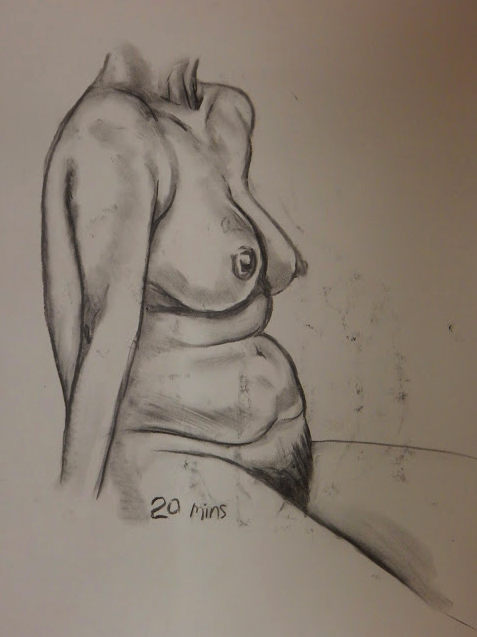
Favourite Life Drawings

A collection of a few life drawings done over this term that I feel show the most progress or are the most accomplished.


Saturday, 21 November 2015

Life Drawing - Week 5


Four five-minute charcoal sketches
One twenty-minute drawing
Two approximately twenty-minute drawings

Monday, 16 November 2015

Video Piece - 'Inside Veins'

A screencap from 'P.T.' showing my favourite camera angle and lighting
 My inspiration for the video piece stems from a combination of literature, music, ambient sound, video games and art. The above is a screenshot from 2014 game 'P.T.', an interactive teaser for 'Silent Hills', a new survival horror game title by Guillermo del Toro and Hideo Kojima that was since cancelled after Konami pulled out of the project. The game uses ambient sound to create a rich, disturbing atmosphere and also uses repeated visual motifs in a unique way that gets a huge emotional reaction from the player. Weather is used for pathetic fallacy, lighting is used to create tension, and ambient noise makes use of minor sound distortions like TV static and radio interference to create a textured sound-scape. There is often the sound of rain against the windows, a lamp creaking, distorted groaning, a fly getting electrocuted by a naked light-bulb - all these ways of using sound to build atmosphere are incredibly inspiring for this video piece.


Likewise, indie horror game 'The Path' uses ambient sound in engaging ways, usually to foreshadow future events. The game has a different repertoire of noises such as swings in a child's play-park, birdsong, trees rustling in the wind and moaning vocalizations that sound either from pain or pleasure. 'The Path' is produced by small Belgian company Tale of Tales, led by Auriea Harvey and Michael Samyn, and explores Gothic motifs reminiscent of 19th Century art in their re-envisioning of the Brothers Grimm fairytale 'The Grandmother's House.' There are recurring visual symbols used in the game and a way of editing cutscenes that gives a surrealist effect, inspiring me for this piece.

https://www.youtube.com/watch?v=rnp4-RoRxSo

The above link features the opening credits sequence to Naughty Dog's 2013 title 'The Last of Us', which features monochrome time-lapse footage of fungi spreading. I've been using the clip as a visual touchstone for the palette of our own piece, as the high contrast and monochromatic filter would create a brilliant tonal contrast. We want to create images of a heart attack occurring, and also display the way that the organ shuts down and eventually withers, and perhaps by taking some vegetable or plants and allowing them to decompose will create a similar effect. If we take photographs of the decomposing matter each day and string these images together to they give the illusion of a time-lapse video we may be able to achieve a similar effect. I hope to use photographs in a stop-frame animation way during this piece as it will add visual texture to the video.

A selection of screenshots from the opening sequence, to showcase the visuals that have been inspiring me

I created a short piece of video experimenting with colour filters, cuts and sound so that I've got a distinct idea of the kind of feel, sound and type of cuts I might want to use in our final video. This was made quickly and spontaneously so that I will have an idea of the tone and atmosphere I want to use. Audio clips are from the internet for the sake of time and creative freedom but in our actual video we will devise ways of creating sound beds ourselves.

A photograph taken before shooting the short video


The above is another short piece of film, this time using only text and sound. I wanted to use fragmented poetry to convey a narrative behind our concept, perhaps even to illustrate the character of the person who is having a heart attack and create a motive and personality for them. I used my camera and filmed myself typing, as I felt this was more nostalgic and interesting than merely typing into iMovie, and it also meant I provided typing noises that felt calming and relaxing. Over these, I sourced rain sound from youtube and layered the sounds to create something soothing. This video is deliberately simple, relying on the observer's ability to use their imagination to create images.

A screencap of the original piece of poetry


We used footage of bubbles in a sink of running water and various filter effects in iMovie to achieve this look of blood rushing through an artery.


The above video is another finished segment of the project - this particular section is made primarily of close-ups and detailing the process of a heart attack. The audio is sourced from online.


Unedited clips that we used for our movement section of the video.


This video is our texture section of the piece, whereby we used our own images of blood cells and textures we thought were appropriate and combined them into a slideshow of images.


 The video above is a stop-motion piece of animation representing the flow of blood around the body and the processes occurring in the body before a heart attack. In the final few frames, the camera zooms in on the heart to represent entering its cells, which links to the textures in the next part of the video.

We collectively brainstormed ideas and edited together. I wrote, shot and edited the text and close-up section, the ink section focused on movement was Abbey's concept and driven by her, and we all participated in making the footage. Katie edited the pieces of film and put them together, and she also had the idea for the stop-frame animation section, which she directed. Abbey and Katie also used their own photographs of cells and edited each photo before we put them together into a slide-show. We chose sound clips and music collectively and most of our efforts were as a group, not as individuals. Our concept behind the video was on portraying the process of a heart attack, and in particular the journey the body and the emotions go through prior and during the heart attack. We were also inspired by the idea that a person will know when they are about to have a heart attack, and that they will have an impending sense of doom. Perhaps the video takes place in the moments before a heart attack occurs and shows an internal perspective, both physically and psychologically, on the process.


Sunday, 15 November 2015

Life Drawing - Week 4


A collection of three-minute charcoal sketches
A twenty-minute drawing focused on a specific detail
Two quicker drawings of detail
A twenty-minute figure drawing

Monday, 9 November 2015

Collage to Painting - 'Game Over'

A digital collage using photography and digital drawing
These digital pieces came about by using a photograph of my previous painting as inspiration for a collage, which would then be translated into another painting. I previously explored the way that society changes, and so in these next pieces I want to investigate further aspects of modern life - in particular, my interest was drawn to technology. Hence, these experimental collages center around how technology is a form of human creative expression. For my next traditional painting, I am also considering playing with pixel art styles and visuals that are reminiscent of the video games I played during childhood. I will be using video games as an allegory for how we approach our real-world choices.
A close-up screenshot to show detail

A work-in-progress print-screen before adding more colour
Another digital collage, this time using the painting itself as a foundation and layering found photographs


A third collage using an image of cells splitting, to experiment with various textures
I was inspired by the video and text work of contemporary artist Ed Atkins, and almost immediately upon seeing a still from one of his pieces I decided that my collage and painting would be focused around varying forms of digital media. I chose to represent a typically non-digital form of art, the collage, in a digital format and also to represent a digital form of art, namely video games, in a traditional format. I wanted to subvert tradition, and I also felt that by having a digital collage as the bridge between the two paintings it allowed for the subject, colour palette and intentions to change drastically, in a way that would be more dynamic than if I had created a conventional layering of physical forms to build the collage. In the same way that a traditional collage juxtaposes different materials, my collage juxtaposes photography and digital art.

What first struck me about Atkins' work is that it is digitally rendered in the way that the assets for a video game character are created, but used for a more explicitly artistic purpose. There is such a realism to these renderings that it is sometimes difficult to tell what is a photograph and what is rendered in a 3D modelling program, and I was also inspired by how Atkins bridges the space between the two mediums - does he take photographs and overlay them atop a 3D model? It is unclear. However, the visual appeal of his work stems for me from the space between computer rendering and photography that it seems to occupy. The intensity of expression in the still above is what engrossed me.

 A still from another of Atkins' projects that I wanted to use as a visual touchstone for how digital media such as video games affects a person's life - often, people use video games for means of escapism, and they desire a genuine emotional connection with a piece of digital art. This created the foundations for my concept.
 It is unclear whether this image is digitally rendered or a photograph.
 This was the first piece from Atkins that I saw, and I immediately loved the tension between text and image.
A still from Atkins' 2014 video project 'Ribbons', which combines 3D rendering and poetry.

 My final A3 painting alongside my digital collage. This painting was based upon the work of Ed Atkins but, most importantly, upon the effect that video games have on people's lives. Video games are not often considered an art form in their own right, despite combining 3D modelling and rendering, screenwriting, traditional and digital art, voice talent, aspects of film-making such as cinematography, and also music and soundtracks. Due to the commercial nature of most popular video games, artistic aspects are often overlooked, despite the art form realizing Wagner's concept of gesamtkunstwerk, one complete artwork. In this piece, I wanted to explore how video games do not offer, as most people think, escapism from the real world, but instead offer a platform to realize the importance of decision-making. I incorporated classic video game aesthetics into my piece to create something visually playful, but also with more serious undertones. In life, there often seems to be two different routes one can direct their life down - there is a more hedonistic, living-for-the-moment approach, and there is also the route of self-preservation and reasoning. I wanted to show the conflict between these different ways of living, and how it is often difficult to make decisions without the aid of other people.
A photograph of the final painting without the collage. I used a pencil, biro and rotring pens to create the drawing before using acrylic and oils for the painting itself.
A detail shot of the figure itself.

Saturday, 7 November 2015

'The Edge' - Painting Project

This project was inspired by 'the edge', whether it be psychological, literal, natural, physical and so on. The edge I chose to depict was that between modernism and post-modernism, not simply in the artistic sense, but in terms of culture. I wanted to highlight the differences between 20th and 21st Century society, and in particular the change in visual styles and progression in issues to do with gender and sexuality. I chose to make a 1950's style oil paint pin-up inspired by Gil Elvgren and subvert 50's culture by creating a camp, sexualised male pin-up who embodies modern 21st Century culture and breaks down gender stereotypes. I juxtaposed modern motifs with a retro artistic style to trace the edge between modernism and post-modernism, and tried to create my own unique synthesis of the two contrasting social environments.

A photograph of the painting near completion
The completed painting with its frame


The above photographs showcase different experiments with painting that I created prior to narrowing down my ideas to my final painting - I used coffee granules, medical gauze, dripping, sugar crystallization, experiments with tin foil and some other techniques to determine the textures and colour palette I wanted to use.

Wednesday, 4 November 2015

Life Drawing - Week 3

Four five-minute charcoal sketches

Twenty-minute study of reclining model

Another twenty minute study of reclining model - my favourite from the session

Fifteen-minute study

Final fifteen-minute study, which I'm not so pleased with - I believe I lost steam and became tired towards the end

Thursday, 29 October 2015

Life Drawing - Week 2

A collection of three minute charcoal sketches
A thirty minute drawing
A twenty to thirty minute drawing where I focused mostly on tone
A twenty minute drawing of the model reclining